Hertz was in the middle of a major rebrand. The visual identity was evolving, but its CRM email program hadn't kept pace. Across lifecycle, triggered, and promotional sends, emails were inconsistent in look, voice, and structure. Production was slow, relying on one-off builds that couldn't scale. And with growing pressure to personalize across a three-tier loyalty program (Gold, Five Star, and Presidents Circle), the existing approach couldn't support the complexity the brand needed.
Hertz partnered with our team to do more than refresh a few templates. They needed a scalable, modular email design system — one that could translate their updated brand into a cohesive CRM experience, accelerate production, and create the structural foundation for meaningful personalization.
Hertz Creative Transformation
From Audit to Architecture:
Designing the System
I led content strategy and creative copy for the project, working in tandem with the Hertz CRM and creative teams. The first step was a full creative and competitive audit, evaluating Hertz's existing email ecosystem against competitor sends to identify gaps in usability, content hierarchy, and brand execution.
From that audit, I defined a messaging framework and content hierarchy that translated Hertz's refreshed brand voice into CRM-ready guidelines: what the brand sounds like in a subject line, in a CTA, in a loyalty milestone moment. Every content decision was made with the customer in mind, asking: does this make the next action obvious and worth taking?
We then designed and built the system in Figma: 50+ reusable, modular components each with documented rules for copy length, tone, and layout that could be mixed, matched, and rearranged across campaigns. I retrofitted the content of Hertz's entire active email program to fit within these modules, ensuring every send felt unmistakably Hertz while eliminating the one-off production cycles that had slowed the team down.
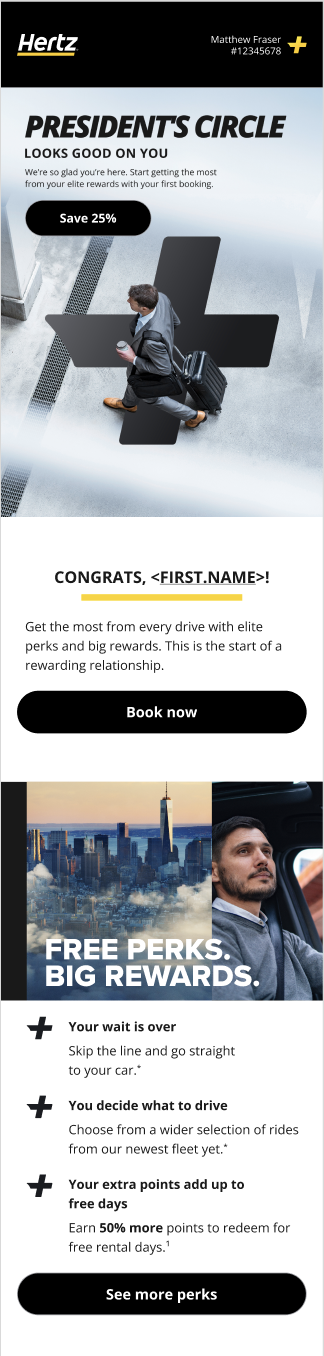
Content Design at Scale:
Writing for Personalization
The system took all elements of the user experience into account. Each module carried specific UI writing decisions: button copy engineered to drive clicks, content blocks structured for scannability, and navigational elements that guided readers toward the most relevant action for their segment.
Because the system had to serve Hertz customers and a three-tier loyalty program, modules were designed to be highly personalized. Copy, offers, and content hierarchy shifted based on the customer's tier, lifecycle stage, and engagement history. The result was a library of components that could power everything from a welcome email to a winback campaign to a loyalty anniversary celebration with each one feeling personal and intentional, even at scale.
Accompanying documentation defined the rules: word counts, voice and tone guidelines, and usage standards for every module, so that teams across the organization could build and launch on-brand emails consistently and correctly without bottlenecking through a single creative team.
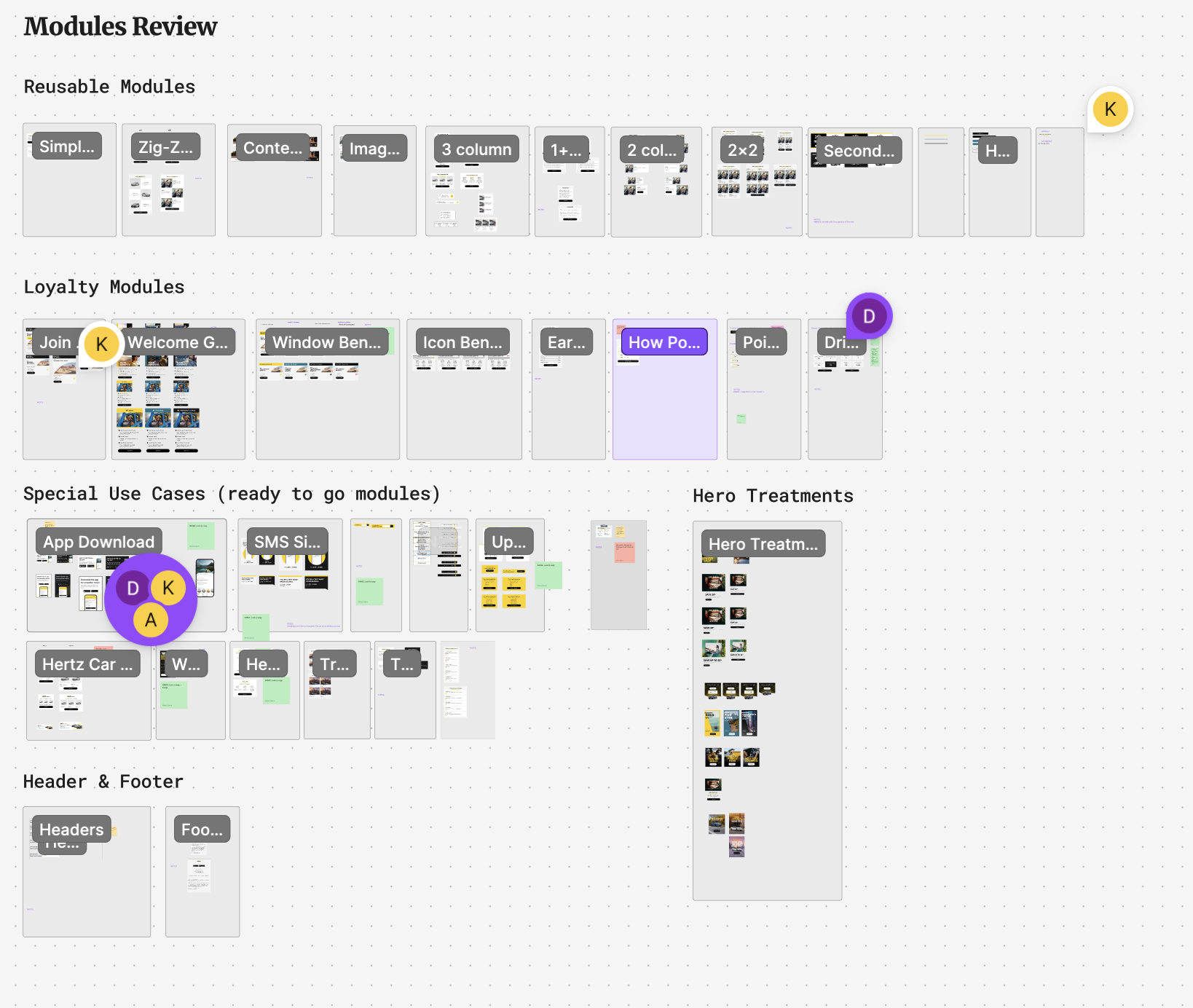
A System That Proved Itself Immediately
The Email Design System launched across 14 campaign segments reaching ~1.4 million emails in its first measured month, and the impact was immediate. 79% of campaigns improved in click rate or revenue per 1K sends, with the strongest gains showing up where content design decisions mattered most:
Tier Confirmation click rates doubled, proving that clearer content hierarchy and loyalty-aware messaging drives action
Thanks for Renting saw a 3.4x click rate increase, the largest single-campaign lift in the program
Free Day loyalty reward emails saw revenue per 1K increase 3.5x year-over-year, with reservations up as much as 3.6x
Welcome, the first email a new customer receives, delivered a 4.5x click rate increase and 7.1x revenue per 1K lift compared to early 2025
But the bigger win is what the system made possible going forward. Hertz now has a scalable creative infrastructure — modular, governed, and personalization-ready — that teams can build on as programs grow and channels expand. By treating content as a system rather than a series of one-off assets, every send works harder for both the brand and the customer.